Privacy Redirect Extension: What It Does and Why It Is Archived
Privacy Redirect is an open source browser extension for Firefox, Chrome and Edge that redirects links for Twitter, YouTube, Instagram, Reddit, Google Search, Google Maps and Google Translate to privacy-friendly alternative front ends such as Nitter, Invidious and OpenStreetMap. Its GitHub repository was archived by the owner on March 10, 2026, so it is no longer maintained.
This page explains what the extension does, how it is configured, and what its archived status means for you.
What Privacy Redirect does
Privacy Redirect rewrites links and address-bar requests so that you land on an alternative front end that loads the same content with less tracking. The extension is officially available for Firefox, Chrome and Edge, and should work in other Firefox or Chromium based browsers.
Once installed, most redirects happen automatically and the requested content loads if the alternative can show it. For example, a link to a Twitter profile opens on a Nitter instance. Services listed in the project's README:
- Twitter (now X), redirected to Nitter
- YouTube, redirected to Invidious or FreeTube
- Instagram, redirected to Bibliogram
- Google Search, redirected to DuckDuckGo or Startpage
- Google Maps, redirected to OpenStreetMap
- Google Translate, redirected to SimplyTranslate
Some alternatives show different content or features than the original site. OpenStreetMap shows the same location, for example, but its information and functions differ from Google Maps.
Privacy Redirect configuration
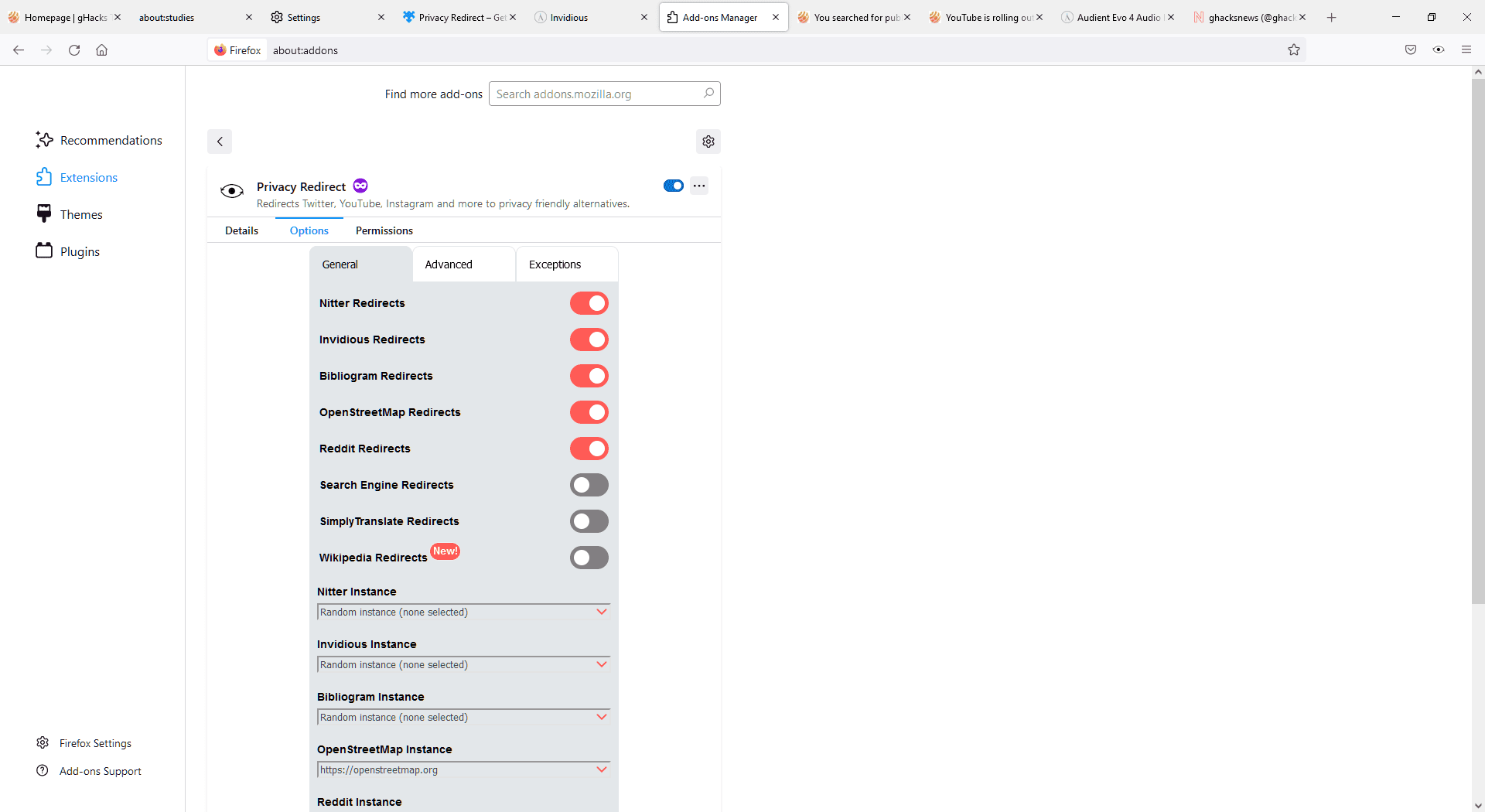
Privacy Redirect needs a visit to its options after install, because not every redirect is on by default. In the original 2021 review, the redirects for Twitter, Reddit, YouTube, Google Maps and Instagram were enabled, while search, translation and Wikipedia redirects were off. You can toggle each service individually.
By default the extension picks a random instance of an alternative whenever you type in the address bar or activate a link. You can instead set one instance as the default target for each service. Instances come and go, so broken ones can be removed under Advanced and new ones added there. The README links to community lists of Nitter, Invidious, Bibliogram, Libreddit and Teddit instances, and you can set a custom instance if the defaults fail.
The advanced page offers extra options for the video and social services: video quality, proxying videos through Invidious, preferring FreeTube over Invidious, redirecting embedded videos only, autoplay, persistent preference cookies on Invidious and subtitle language codes. A third tab sets exceptions, either as plain URLs or as regular expressions that exclude sites from redirects.
Is Privacy Redirect still maintained?
Privacy Redirect is no longer maintained: the repository on GitHub is archived and read-only since March 10, 2026. The extension may keep working in your browser as long as the alternative instances it points to stay online, but it will not get fixes for broken instances, browser changes or new front ends.
Several of the alternatives it relies on, such as Nitter and Bibliogram, depend on volunteer-run instances that were often unreliable even in 2021. If redirects fail, remove the dead instance in the options or choose a custom one. Before you install it, check the browser store listing and the repository for the current state, and look for an actively maintained redirect extension such as LibRedirect (see below) if you need reliable results.
Alternative front ends in 2026: LibRedirect, Invidious, Redlib and Piped
LibRedirect is the closest maintained replacement for Privacy Redirect: its GitHub repository is not archived and its latest release, 3.5.1, was published on 4 November 2026. It is a browser extension for Firefox (from Mozilla Add-ons) and Chromium based browsers (installed from the project's documentation) that redirects YouTube, Twitter and TikTok links, among others, to privacy-friendly front ends. As of 19 November 2026 the project page does not list every supported service, so check the extension's options for the current list.
The front ends themselves differ in how alive they are, and the status below was checked on 19 November 2026:
- Invidious (YouTube): maintained, with release v2.20261114.0 dated 14 November 2026. Its changelog mentions companion support and earlier fixes for YouTube backend changes, so a given public instance can still fail when YouTube changes something.
- Piped (YouTube): not archived, with the latest commit on the repository dated 8 November 2026 (a translations merge).
- Redlib (Reddit): a fork of Libreddit, written in Rust, with the latest commit dated 22 October 2026. Public instances are listed in a separate instances repository, and its README describes measures against Reddit rate limits, so expect some instances to be down.
- Nitter (Twitter/X) and Bibliogram (Instagram): not re-checked for this update. Both relied on volunteer instances, so treat them as unreliable until you test a working instance yourself.
Public instances are run by volunteers and come and go, which is the same weakness that affects Privacy Redirect. Pick an instance from the project's own instance list, and set a second instance as a fallback if the extension allows it.
Closing words
Privacy Redirect improved privacy by sending popular services to lighter alternatives, and it worked well in the original tests apart from the initial problem with non-working Invidious instances. As an archived project it is best seen as a reference for how front-end redirection works rather than a long-term solution.
Now You: do you use alternative front ends for the sites Privacy Redirect covers?
Related: ClearURLs for removing tracking from links, Firefox removing tracking parameters from URLs, uBlock Origin Lite for Safari
Source: Privacy Redirect on GitHub

URL disabler offers much more comfortable blocking method
https://www.sordum.org/13075/url-disabler-v1-0/
It’s been a while I am using this extension and I like it but there is one point that annoys me: you can’t change the instances on the fly. You have to open a new tab to display the options. It is really cumbersome knowing that invidious’ instances are really unstable and need to be changed constantly (though it’s better now than months ago).
Invidition was better in that regard but the creator alas stopped maintaining it. :(
Another good alternative would be Violentmonkey + Greasy Fork scripts…
https://violentmonkey.github.io/
https://greasyfork.org/en
@ryuk, not that I know within Bibliogram instances given the problem is apparently not that of Bibliogram but caused by Instagram itself. Here is Instagram’s notification when a user’s page is opened with a Bibliogram redirection (tested with several Bibliogram instances) :
“Timeline loading blocked
Instagram is refusing to provide data to this server.
This server will only be able to load the first page of timelines.
This error is permanent.”
Another front-end than Bibliogram? I know none. But don’t take my word because I haven’t been zealous with redirections to Instagram given my lack of interest, contrarily to Twitter posts.
OK, thanks, appreciated!
Perhaps a change of platform is a better idea…
https://pixelfed.social/
@ryuk, thanks for the link, I’ll have a look.
P.S. After so many years here on Ghacks I still happen to mistake when answering : I replied to your comment with ‘Post Comment’ rather than with ‘Reply’ which broke the hierarchy :) I point this out because I happened to miss answers when the reply to my comment wasn’t underneath …
Concerning UserScripts : feasible if the intent is to visit Instagram without logging in, but to do so without actually opening Instagram (all Facebook and dependencies are blocked in my case) you’ll always need a ‘transit’ server, of course.
teddit.net > reddit.com
rumble > youtube… needs more time for the great migration, invidious in the meantime.
in search of a replacement for wikipedia.
Maybe this one will suit your needs…
https://wikiless.org/
This type of plugin is called an URL ReWriter.
They all use wildcard/regex to work on any URL.
“Hacks”
You keep using that word, I don’t think it means what you think it means.
I’ve been using ‘Privacy Redirect’ for some time. The best in its category, IMO.
Personally I don’t use all the redirects :
Nitter : yes
Invidious : yes
Bibliogram : no, because Instagram blocks the redirected content.
OpenStreetMap : no, because the developer himself agreed it needs more work.
Reddit, yes
Search engines : no
Simply Translate : no, even if it allowed me to discover [https://translate.metalune.xyz] : worthy
Wikipedia : no
I won’t elaborate except for Invidious, would be too lengthy.
Invidious, the primary reason for which I installed ‘Privacy Redirect’.
I choose the option ‘Only redirect embedded video to Invidious’ and another extension, ‘Redirector’ for non-embedded YouTube videos, because I move my Invidious instance among six I consider to be the most reliable, none hosted by Cloudflare, and each with their cookie. ‘Privacy Rediector’ redirects with the user’s chosen parameters (or default) and this cannot be disabled : these parameters don’t include all Invidious options so I end up with a redirected url which is bothering given the cookies. A bit more complex redirecting cooking recipes here but I won’t detail.
Privacy Redirector is an eminent component of my privacy environment.
Hint : the best two reliable Invidious instances, over time, are, in my experience, [yewtu.be] and [invidious.snopyta.org], the most successful as well : see [https://api.invidious.io/]
Is there a privacy respecting Instagram front-end alternative to Bibliogram that actually works?
I use it mainly for Twitter -> Nitter and it’s great for that. I have tried it for Reddit to old.reddit but it doesn’t work quite as well as the Old Reddit Redirect FF addon – I’m not sure quite how to explain it but it seems to miss some URLs?
I also use it on my phone (yep, still using 68 :p) for Reddit -> Teddit.
This works without problem for me
https://chrome.google.com/webstore/detail/dneaehbmnbhcippjikoajpoabadpodje
I hope this extension continues to be refined to the point that is becomes indispensable to a privacy conscious internet public.
So even Wikipedia is a privacy-offensive site now?
@Marcin
Yes, they are for quite a while now, a wholly owned subsidiary of the Ministry Of Truth.
Edited by the woke-est of the woke. As are pretty much all of main stream social media…
Even if they were “the woke-est of the woke”, they are not tracking you across the web to create profiles or sell your data to third parties so your answer is pretty much as moronic as it sounds.
Wikiless says that the two reasons to use their service are:
*Circumvent censorship
*You prevent Wikipedia getting your IP address
The second point is not about “wokism” but all about the NSA infiltrating Wikipedia.
Even the creator of Wikiless doesn’t agree with your moronic stance.
Yeah, a butt-hurt Wiki editor chimes in, not with reasoned points and objections, but with name calling and cry baby whining. Your job there is obviously secure.
LOL
Exactly!!!
I tried it a few weeks ago. It worked, but at the time the extensoon had a habit or reseting itself to defaultif I set something to not redirect, such as stopping the invideous redirects. So I stopped using it.
how long before Brave steals this and markets how wonderful they are
– added tor mode, doesn’t contribute upstream and undermines Tor Browser (and users)
– added native adblocking to enable them to extort advertisers and uses lists from others without contributing
– added a repackaged jitsu, doesn’t contribute
– adds bounce tracking using lists from others
– and more
nothing brave does is original
@marvin
> nothing brave does is original
It’s worse than that, add these to the list
– They use HTTPS-Everywhere’s upgrade rules
– They use chromium without upstreaming their token minimalist gimmicks (and they added telemetry, for what? they don’t do anything)
– They hijack existing adverts to threaten creator’s revenue streams .. nice site you have there, shame if something happened to it
– Lets not forget they inserted and sent affiliate referrals on some eTLD typed urls – not searches, but typed urls, which no other mainstream browser has ever done
– And their jitsi rebrand requires that Brave Rewards be enabled
Typical advertising company funded by venture capitalists. All smokes and mirrors.